

evaluate() returns an EvalRunResult — a summary per metric, one result per case, and where the run reported.
Summary
summary() prints one line per metric:
threshold to be judged — without one it’s averaged, and pass=k/n is left off.
- Python
- TypeScript
Per-case results
- Python
- TypeScript
case_id, input, output, expected, scores, trace_id, duration_ms, and any error or scorer_errors. A case that hit an error is errored; use case_status(item) / caseStatus(item) to check.
The run also exposes counts (case_count, errored, not_scored), the candidate_version it was labelled with, upload_state with the run’s dashboard_url, and dataset — the exact dataset version the run measured.
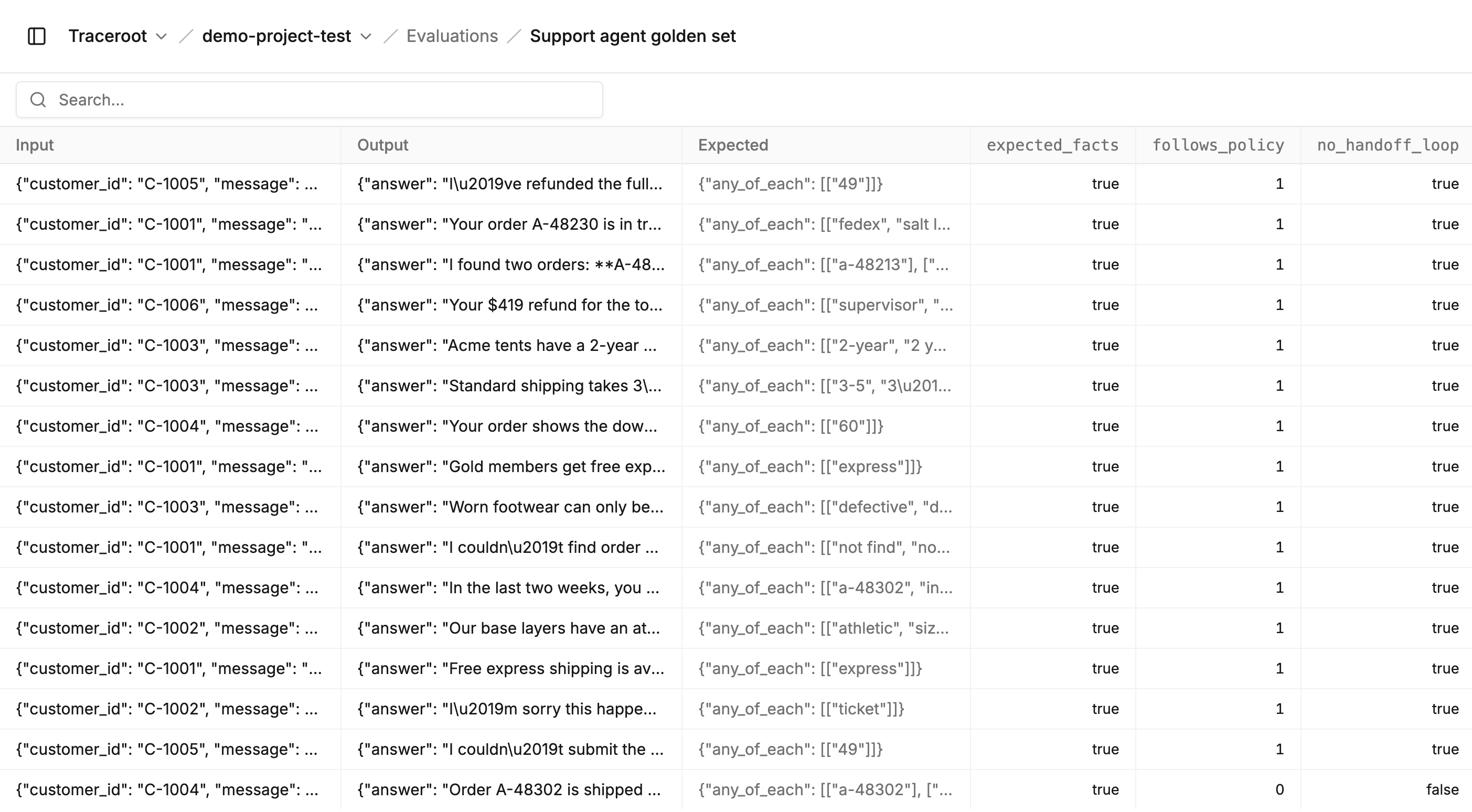
Evaluation run: each case's input, output, expected answer and scores
Upload later
Save a run and upload it afterwards, for when the run happens somewhere without credentials.- Python
- TypeScript
upload() rebuilds the reporting destination from the saved run, and keeps its scorers’ thresholds — so a later upload records the same pass and fail results as the original run.
Reading a run later
EvalRunResult is what the process that ran the eval holds. Once the run has reported, the CLI reads it back from anywhere — including a run somebody else started.
Next steps
From the Terminal
Read datasets, evaluations, and past runs with the CLI.
Running Evals
Every option of
evaluate(), and where a run reports.Datasets
Pull a dataset version to reproduce a past run.